

 Mahnoor Khan
  September 2, 2026
  Mahnoor KhanSeptember 30, 2026
You spend thousands of dirhams driving traffic to your UAE website with no results.
The design is modern. The offer is competitive. Yet, your bounce rate is stubbornly high, and lead conversions remain low.
What went wrong?
You are likely forcing a massive audience of your market to think, read, and translate your website as English is their second language. In the UAE, English is understood, but Arabic gets you trusted.
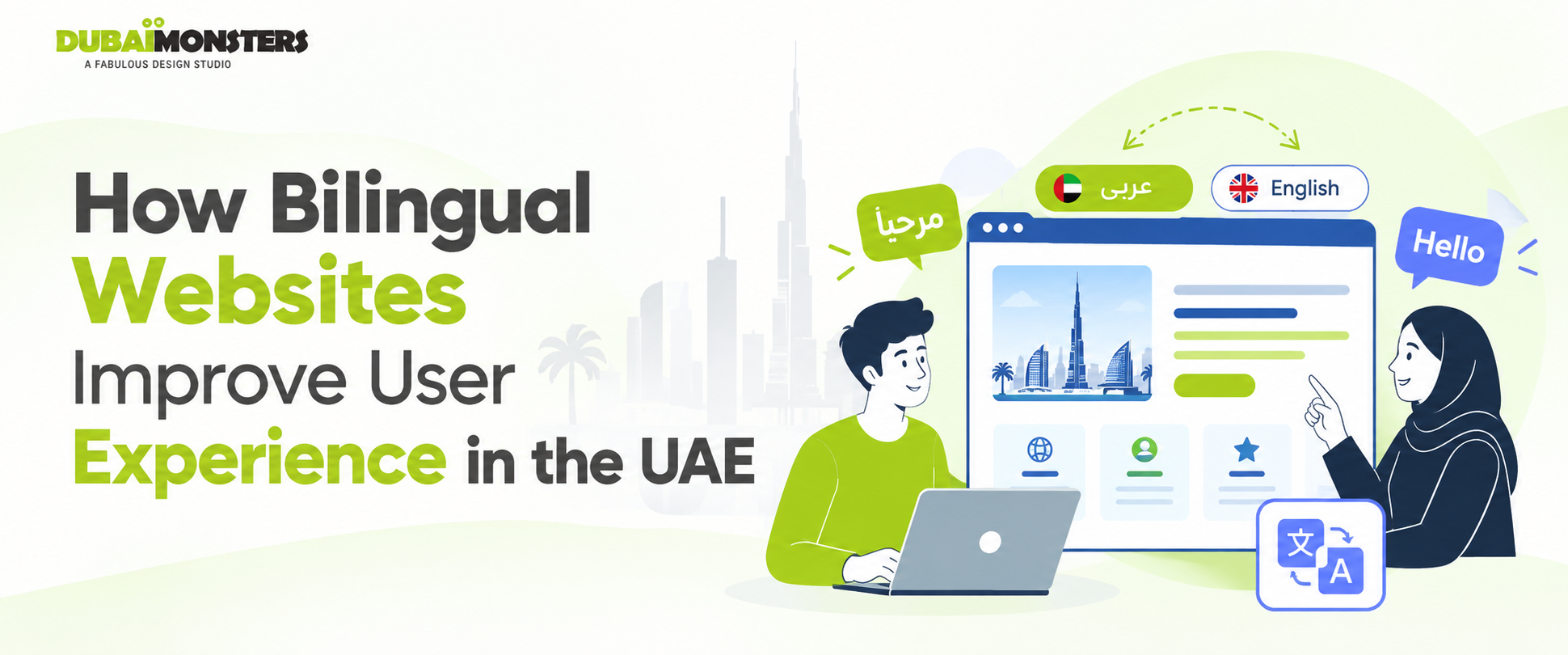
Bilingual website design is the architectural and visual optimization of a digital platform to serve both Left-to-Right (LTR) English audiences and Right-to-Left (RTL)
Native Arabic audiences understand the local language. It reduces cognitive friction, making it effortless for your audience to find information and take action.
Here is exactly how a bilingual UX strategy drives measurable revenue in the UAE market, and how to implement it correctly.
Table of Contents
The UAE internet penetration rate sits at a staggering 99%.
However, the demographics using that internet are split.
While English is treated as the corporate standard for expats and the international market, Arabic is the official language in the UAE.
When you run an English-only website in this environment, you create three immediate problems:
While some of the English search terms are highly competitive, Arabic commercial search queries are vastly underserved. You are missing out on cheaper, higher-converting organic and paid traffic.
Many UAE government entities and large-scale local enterprises mandate Arabic documentation and communication for procurement.
Consumers inherently trust websites that speak their native language. Forced mental translation creates hesitation, and hesitation kills conversions.
Find Out: 8 Web Design Tips for Better User Experience
A high-converting website removes every possible obstacle between the user’s problem and your solution. Language is the very first obstacle a user encounters. Here’s how it impacts conversions.
Cognitive load is the amount of mental effort required to understand a webpage. When an Arabic speaker has to mentally translate your English service pages or struggle through a poorly auto-translated checkout process, cognitive load spikes.
A native, culturally adapted Arabic interface allows the user’s brain to relax, focus on the value proposition, and click the CTA.
In the UAE market, trust is the key to success. Having a professionally localized website demonstrates that your company is here, that you honor local culture, and that you care about your local customers. The opposite, however, is a broken Google Translate widget, and it indicates laziness and a lack of commitment to the local area.
When it comes to B2B sales cycles, someone doing research on your software may want to hear it in English while the person making the decision to approve the budget wants to hear it in Arabic. A good two language website allows visitors to both parties to feel at ease when viewing your offer, helping to speed up the sales process.
Read more: The Website Redesign Strategy That Drives More Leads
Flipping a translation mode in your website CMS will not improve your UX. It will likely break your layout. To create a high-converting bilingual web design, you need to follow a process.
Avoid using automatic translation parameters (such as ?lang=ar).
Have separate subdirectories for each language ([yourdomain.com/en/](https://yourdomain.com/en/) and [yourdomain.com/ar/](https://yourdomain.com/ar/)).
Employ the use of hreflang tags with your site’s header to signal to Google that you have both versions of your site available, and that they should index them correctly, giving them to the searcher based on their geographic and browser settings.
The Arabic language reads from right to left. It’s not enough to put the text to the right and come up with a “right-to-wrong” solution. It takes the entire user interface to be changed.
Arabic is read from right to left. You cannot just align the text to the right and call it a day. It takes the entire user interface to be changed.
The above image clearly shows what an Arabic website looks like. From right to left navigation and content to image text overlay, every element is designed for a local audience.
Literal translation implies confusion. The locals not only translate, but they:
Forms and CTAs need to be completely frictionless, in both languages.
Make sure form fields mirror correctly and input Arabic characters is smooth.
Avoid generic CTAs. Use action-oriented Arabic microcopy that offers value instead of just saying “Submit” – for example, “احصل على استشارتك المجانية” (Get Your Free Consultation).
Read more: What is Website Design Cost in Dubai: A Complete Breakdown
If you are considering a quick fix, here is why automated translation plugins actively harm your UX and SEO:
| Feature | Automated Plugins (Google/Bing Translate) | Native Bilingual Website Design |
| UX & Layout | Frequently breaks RTL alignment and overflows text boxes. | Custom-coded mirroring ensures a flawless, native experience. |
| Copy Accuracy | Literal translations often result in embarrassing, confusing phrasing. | Culturally adapted copy written by native marketing professionals. |
| SEO Visibility | Search engines often cannot crawl or index the translated content. | Dedicated URLs and metadata allow you to rank for Arabic keywords. |
| Brand Trust | Signals a cheap, low-effort approach to the local market. | Projects authority, premium quality, and market commitment. |
Planning to build a bilingual website for your brand? Get in touch with our expert team to create a user experience for your audience!
You remove mental barriers, resonate with cultural norms, and provide a seamless RTL experience, preventing you from losing out on potential customers and turning them into actual ones. If you’re not serving the Arabic speaking market, your website is giving high-intent leads to your competitors.
Looking to create a bilingual website design that both languages?
Explore Dubai Monsters’ expert bilingual web design services and let us engineer a localized platform designed specifically for the UAE market.
Yes. When your audience is bilingual, presenting the information in their native language will ease the barriers, save time on the page, and develop subconscious trust. Also, it provides you with Arabic keywords for your search, which can give you an edge in search engine optimization.
Mahnoor Khan
September 2, 2026  Mahnoor Khan
August 18, 2026
Mahnoor Khan
August 18, 2026 Table of Contents
