

 Junaid Ashraf
 October 20, 2026
 Mahnoor KhanOctober 28, 2026
The winning angle in creating best performing website isn’t choosing between custom vs. template website.
But it is about understanding what businesses in Dubai are doing out of the box that clicks everytime.
A professional website built from a ready-made template can go live sooner, and covers the basics. But it doesn’t make the real impact. A custom web design, with a layout built around the business, offer better scaliblity. The price is higher, and the project may take longer but it will be worth it.
At first glance, the decision seems simple: either you pick a template or pay more for a custom website.
But the cheaper quote doesn’t always mean the lower long-term cost. And a custom website isn’t automatically worth the extra investment.
A business does need a website that is non-negotiable. But the real question is: how can a Dubai business choose the right website approach without overspending?
Let’s break it down.
Table of Contents
Before you even start comparing the type of website, understand why you even need one. You can pick the most trendy themes, or get cheap development quote but if a website doesn’t fulfill the requirements it won’t make an impression.
For some businesses, the website is an online introduction. Its the first the look that makes an impact. It consist of company’s contact details that allow them to connect with potential leads.
For others, it is where customers browse products, book appointments, make payments, or manage ongoing transactions.
These are different requirements, and the website budget should reflect that difference.
Before you request a quote, answer three questions:
These answers will give you a practical starting point, helping you to think beyond just a template design.
Be it a template website or a custom website, it’s important to understand what you’re actually paying for.
A modern theme, unique design or features, everything makes a difference. But the real difference is how the site is put together to create a business profile that actually makes an impression.
A template provides a ready-made layout that can be adapted as per your branding, text, images, colours, and content. Depending on the platform and theme, it is easy to add forms, booking tools, ecommerce functions, and other features for improved functionality.
The main advantage is that you get the foundation. Your developer or internal team doesn’t need to design from scratch.
A website owner can select a suitable layout, replace the sample content, add the services, and launch without a custom layout.
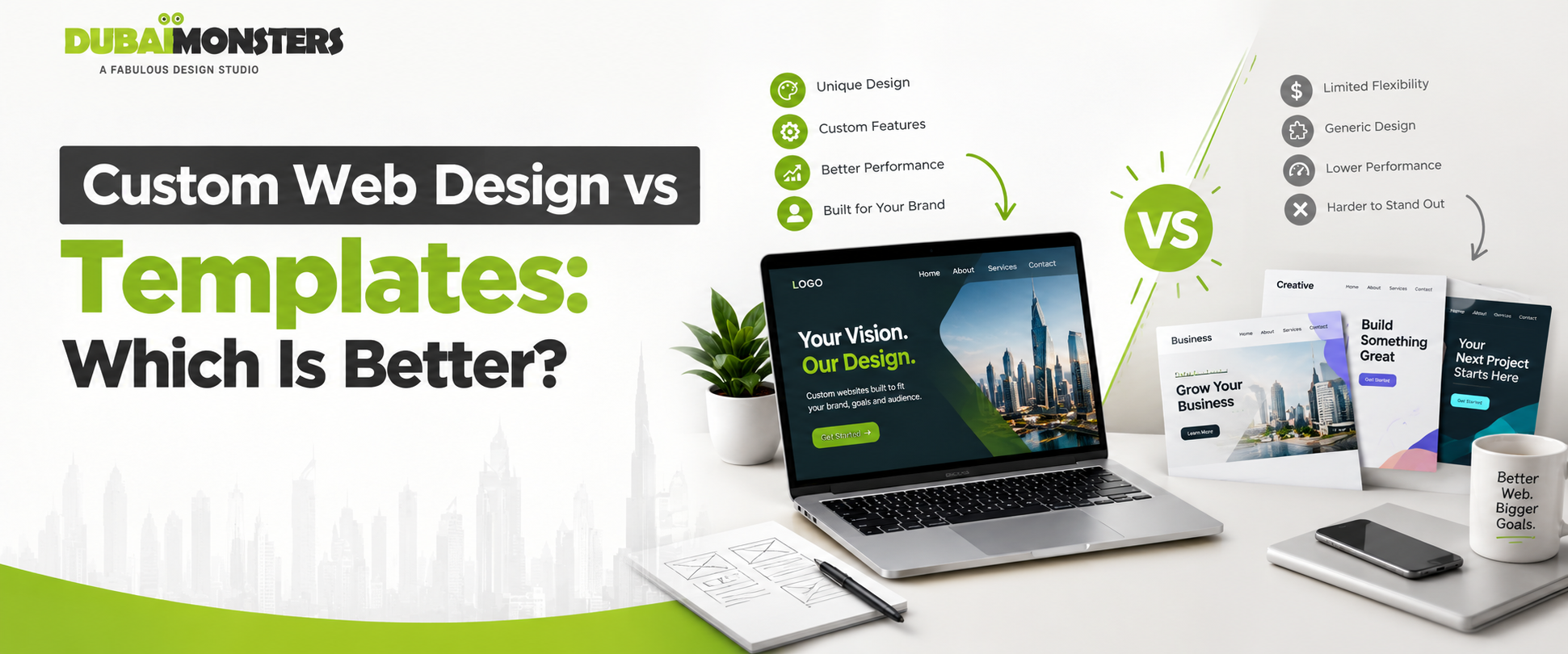
Custom web design creates different possibilities. Before you put structure to the work, you need to understand the requirements. From structure to visual design, user journey to pre-planning, everything is important. Your company’s goals need to be the primary requirement for a pre-existing layout.
A custom website gives the team more control over how those experiences are designed. It can also provide more freedom when integrating business systems or adding functionality that standard themes do not support.
If the requirements are simple, custom development may add cost without delivering enough additional value.
The choice becomes easier when you compare the factors that affect your business rather than judging websites by appearance alone.
| Decision factor | Template website | Custom website |
| Initial investment | Often lower when requirements are standard | Usually higher because more design and development work is required |
| Time to launch | Can be quicker if the content and features are ready | Depends on the scope, design process, and development requirements |
| Design flexibility | Works within the template’s structure and capabilities | Gives greater control over layout and user journeys |
| Special functionality | May need plugins, extensions, or workarounds | Can be built around specific requirements |
| Future changes | Simple edits may be easy; structural changes can be restrictive | Can be planned around expected changes, though new work may still cost extra |
| SEO | Can support strong SEO with the right technical setup and content | Can support strong SEO with the right technical setup and content |
| Maintenance | Depends on the platform, theme, plugins, and support arrangement | Depends on the technology, code quality, hosting, and support arrangement |
| Best fit | Businesses with standard requirements and a limited launch scope | Businesses with specific functionality, customer journeys, or integration needs |
One detail deserves attention can help you make a better choice.
A template may require theme and plugin updates, compatibility checks, and security monitoring. A custom website may require developer support, software updates, testing, and changes as the business evolves.
The right comparison is not simply which option costs less to build. It is which option delivers the required experience at a cost the business can sustain.
Not every time choosing a website template is the wrong idea. In some cases opting for template website is a wise choice that actually benefits your business. If it’s a new startup, the service offering is clear, and the immediate priority is to attract its first clients.
A template website may suit your business if:
This can be a more profitable route for freelancers, new consultancies, small service businesses, and companies testing a new offer.
However, a lower initial quote should not be the only reason to choose a template.
A template is a cost-effective choice when it meets the brief without forcing the business to compromise on requirements that matter.
Read more: The Website Redesign Strategy That Drives More Leads
Your customer journey needs more than a standard layout.
A business may need visitors to follow a particular path before they enquire or buy. For instance, a company serving several industries may need different service pages, tailored enquiry forms, and case studies matched to each audience.
If the template makes that structure difficult to create, a custom approach can give the business more control over how visitors move through the website.
The goal is not to make the site look different for the sake of originality. It is to help visitors find relevant information and take the next step.
Other companies require their website to communicate with a CRM database, inventory system, booking system, payment processor, or an internal database.
These connections can be made with a template-based site via existing integrations. If it is believed that those integrations meet the requirements then custom development might not be needed.
The choice is different if the business requires intricate data flows, specific permissions, or functions that current tools can’t adequately support.
Prior to custom development, inquire if a successful integration can resolve the issue. Creating a feature from the ground up isn’t always the most reasonable choice.
Anyone who thinks about using a website for their business should take into account the services that they want to offer, the markets that they want to break into, and the more complex sales process that they intend to use.
A custom build can be planned with pre-determined expansion points. This does not imply that all future features need to be constructed on the spot. It implies that the original structure should take into consideration changes which can be reasonably anticipated.
For businesses competing in a crowded market, the website may need to communicate a specific positioning through its layout, content hierarchy, interactive features, and customer journey.
Custom web design offers greater freedom to shape that experience. But a unique design only has business value if it makes the company easier to understand, trust, or buy from.
A distinctive homepage cannot compensate for unclear service descriptions or a difficult enquiry process.
Can’t decide between custom or template web design? Get in touch with our expert web team to make the right choice.
The first quote is only part of the financial picture.
Suppose a template website costs less to launch. Six months later, the company wants to introduce online bookings. A few months after that, it needs additional service pages and a connection to its CRM.
Some of these changes may be straightforward. Others may require paid extensions, developer work, or a change to the original structure.
To compare the two options fairly, it’s important to estimate the total cost of ownership.
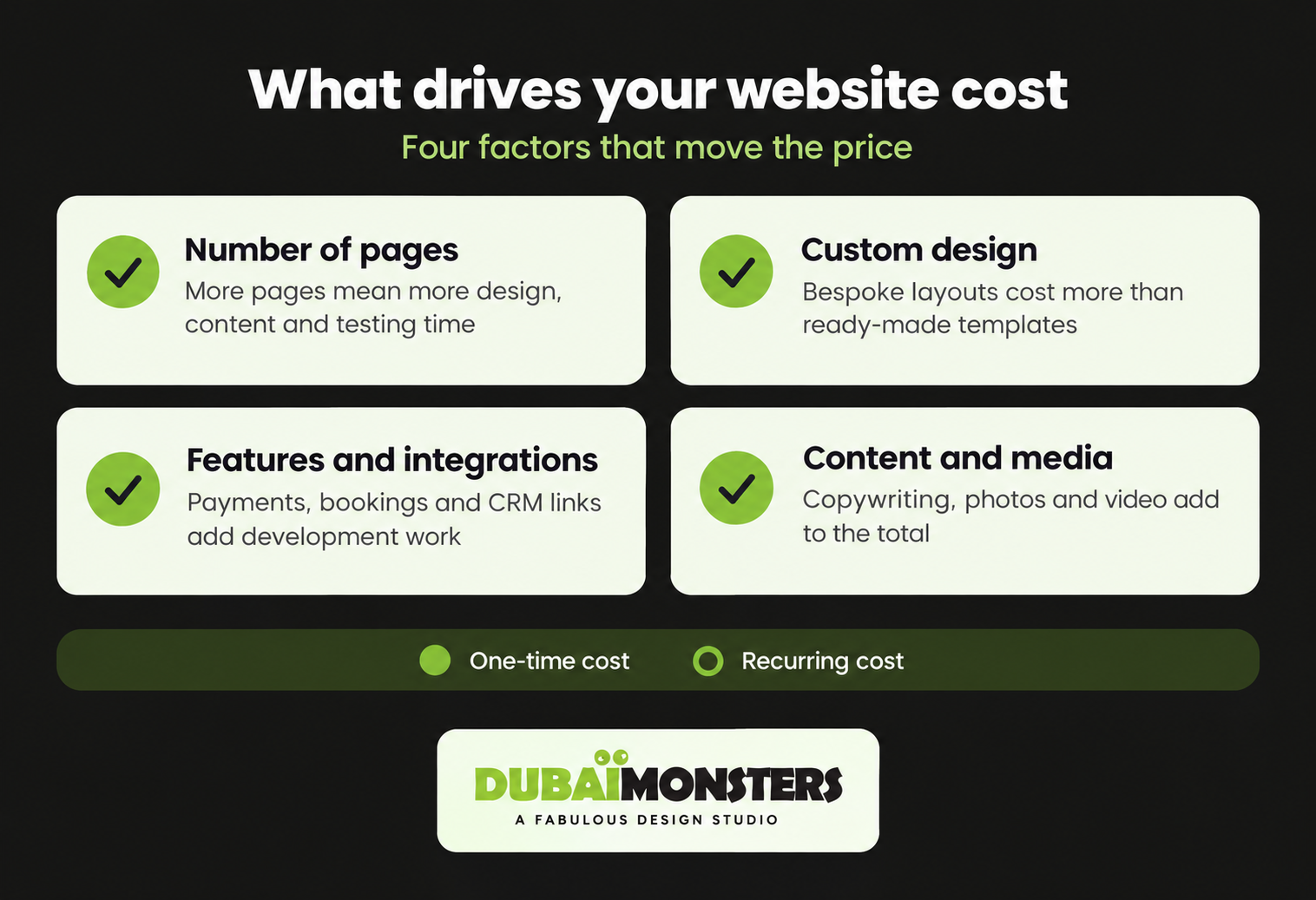
| Cost item | Template-based | Custom |
| Design only | A premium template costs about AED 500 to 2,000 | A fully custom UI can cost AED 8,000 to 30,000 for design alone |
| Small business website | AED 3,000 to 7,000 for a basic template-based site | AED 8,000 to 15,000 for a custom-designed business site |
| Larger business or corporate site | AED 7,000 to 35,000 for a professional WordPress build | AED 25,000 to 120,000+ for a business-grade custom build |
| Complex platforms and enterprise | Not a good fit | AED 120,000 to 300,000+ for web applications, platforms and enterprise systems |
| Hosting (per year) | AED 1,200 to 3,600 for managed WordPress hosting | AED 3,600 to 12,000+ for VPS or cloud servers |
| Launch Time | About 2 to 8 weeks for WordPress | About 2 to 6 months |
For a useful comparison, ask each web design provider to estimate the initial project cost. Separate confirmed fees from estimates for work that may or may not be needed.
You do not need to predict every future requirement. Focus on the changes your business already expects.
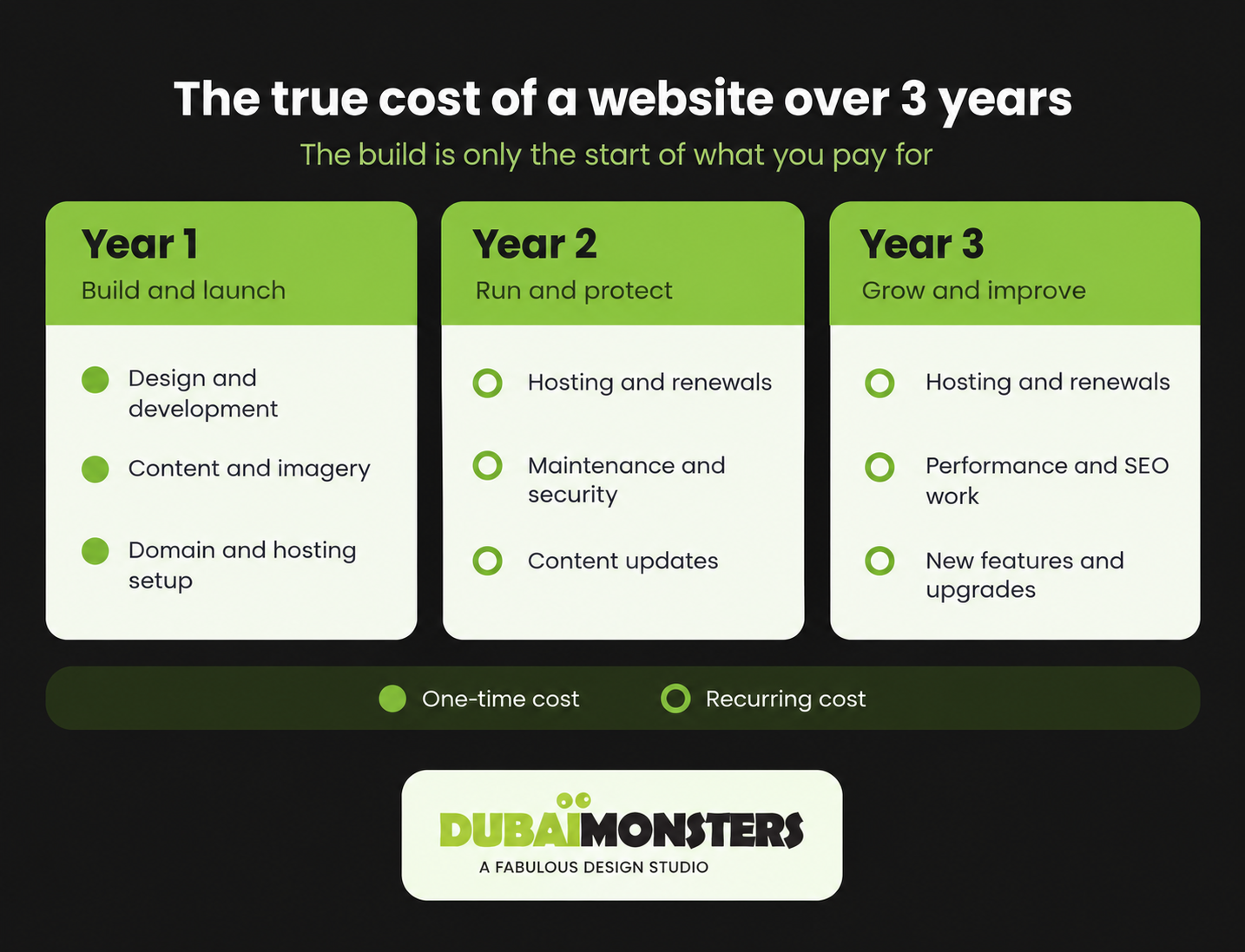
Use this calculation for each proposal:
Estimated three-year website cost = initial build + hosting and licences + maintenance + planned changes + expected integration costs.
If it requires repeated paid extensions and expensive modifications, the gap between the two proposals may shrink.
A custom website may be justified if it handles those requirements of a business.
The costing figure may vary as per the scope and provider. Request quotes rather than relying on a general claim that templates or custom websites are always cheaper.
A business that is not found on Google is not the one that gets customers. An owner investing in a new custom build website can help improve search rankings. That expectation needs a closer look.
Custom web design does not automatically improve SEO. Google evaluates many aspects of a website, including the relevance and usefulness of its content, its accessibility to search engines, and the experience it provides to users.
A template can support a search-friendly website. It can help manage page titles, headings, metadata, internal links, URLs, image descriptions, redirects, and other technical requirements.
Before approving either option, check the following:
Anyone who thinks about using a website for their business should take into account the services they offer.
A custom build can be planned with pre-determined expansion points. This does not imply that all future features need to be constructed on the spot. It implies that the original structure should take into consideration changes which can be reasonably anticipated.
Read more: What is Website Design Cost in Dubai: A Complete Breakdown
A website for a Dubai business may need to do more than present services in an attractive layout. Depending on the target audience, it may need to support Arabic and English content, work across mobile devices, and guide visitors towards a relevant local enquiry or purchase.
These requirements should influence the choice before development begins.
A bilingual website is not simply a translation of the English version.
Arabic content needs a right-to-left layout with proper, relevant content. The navigation, menus, and spacing everything should align with the content.
Some templates handle right-to-left languages well. Others may need considerable modification. A custom build can provide more control over the experience, but the team must still plan and test it properly.
Explore: How Bilingual Websites Improve User Experience in the UAE
A prospective customer might discover your business while commuting, browsing between meetings, or comparing providers on a phone.
If the website has small buttons, awkward forms, slow-loading images, or confusing navigation, the visitor may leave before making contact.
Both template and custom websites can provide responsive web design. What matters is how the final site behaves on real devices, not whether the proposal describes it as mobile-friendly.
A company targeting customers in Dubai may need clear service areas, relevant contact details, location information, and enquiry forms that ask for the details the sales team needs.
A template may support these requirements without difficulty. A custom build becomes more relevant if the business needs a more involved quotation process, different enquiry paths for different services, or connections to internal systems.
These are business requirements first and design decisions second. Make a list of them before selecting the technology.
The choice does not have to be completely custom development or an untouched template.
A customised template can provide an existing foundation while allowing a designer or developer to adapt the layout, colours, typography, page structure, and selected features to the business.
For a company that wants a more distinctive website but does not need complex functionality, this approach may offer a reasonable balance between cost and flexibility.
At this point, the decision should be based on the requirements you have identified, not on which option sounds more advanced.
Use the following checklist before approving a proposal.
A template may be the better fit if:
Custom web design may be the better fit if:
A customised template deserves consideration if:
These are starting points, not rigid rules. A template can support a sizeable business, and a custom website can be unnecessary for a small company with straightforward needs.
A website should support the business you are running today without creating unnecessary barriers.
Building a website means aligning it with the business you want to build tomorrow.
You need to define your requirements as the first step. It is then important to compare the full costs and ask providers to explain the reasoning behind their recommendations.
Planning a new website or considering a redesign? Dubai Monsters provides solutions for businesses with different requirements.
Be it modern brand websites or ecommerce, we provide solutions for all your requirements. Share your goals with our website development team to get started.
Custom web design offers greater control over the site's structure, functionality, and user journeys. A template can be a better fit for businesses with standard requirements and a limited budget.
Junaid Ashraf
October 20, 2026  Mahnoor Khan
October 13, 2026
Table of Contents
