

 Mahnoor Khan
 October 13, 2026
 Junaid AshrafOctober 20, 2026
Walk through any business exhibition in Dubai and you’ll collect a stack of brochures before lunch. Most get skimmed and forgotten.
A few stay in your bag because they were easy to read, clear about the service, and told you how to get in touch.
The rest starts with a sales pitch on the very first panel.
Which one would you engage with? Most probably the one that made information easy to find.
A brochure gives potential customers something to read, pass along, and come back to when they make the real decision. Plenty of brochures never manage that.
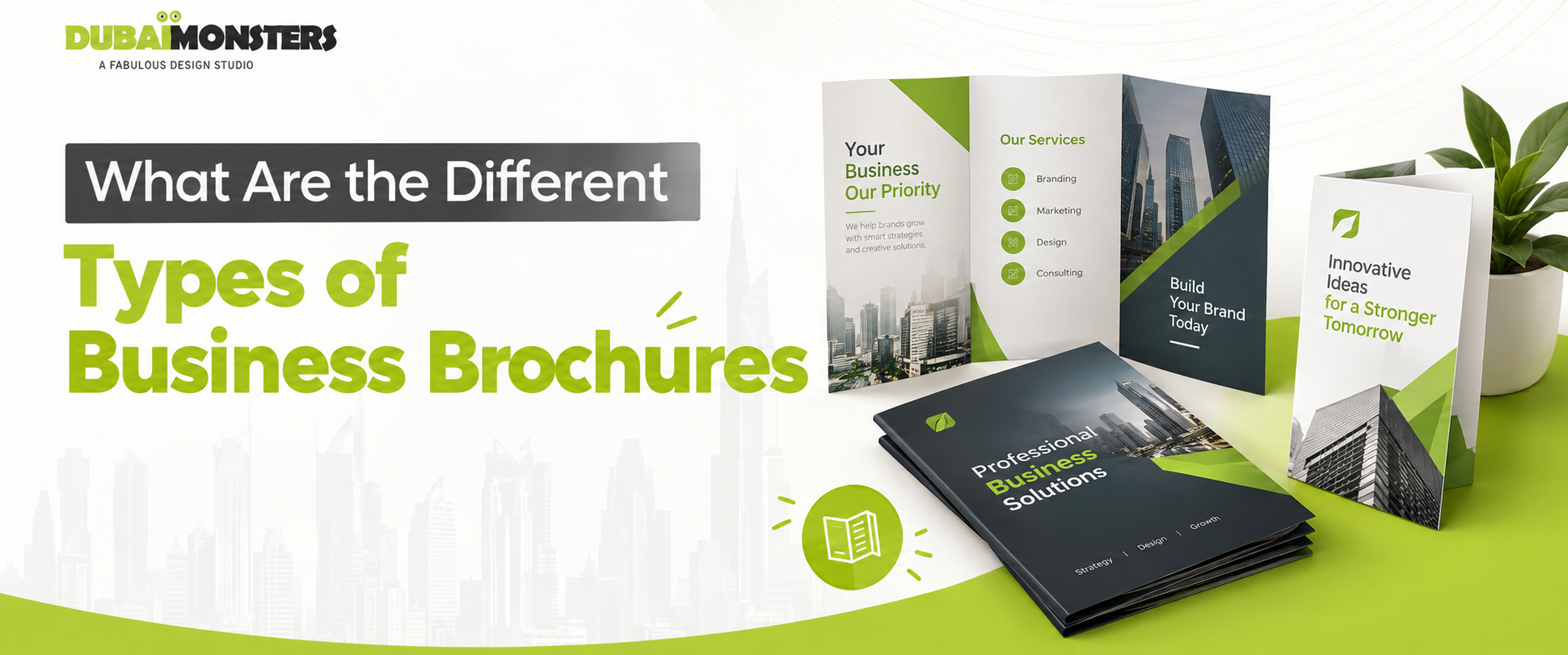
Here are the business brochure types worth knowing, and when each one fits.
Table of Contents
A business brochure is a marketing document that tells a lot about a company. Its products, services, or offers. It can be printed or shared digitally, depending on how you reach your audience.
Companies use brochures for different purposes. A service provider lays out its packages for prospective clients. A manufacturer showcases its product range. Whereas a marketing agency states its services.
Unlike a flyer, a brochure has room to split information into sections. You can fit specifications, customer benefits, visuals, and contact details without cramming. Teams hand brochures out in meetings and at exhibitions, or send a digital copy to a prospect afterward.
Brochures come in many shapes. Bi-folds split content into a few panels. Others stretch to eight panels or run to dozens of pages. The best one is the one that gets your message across.
Here are ten common types.
A bi-fold brochure is a single sheet folded in half. You get four panels: a front cover, two inside panels, and a back cover.
The layout is simple, which suits businesses that want to share the basics without splitting content into many sections.
Best suited for:
The panels are large, so there’s space for photography, headlines, and short blocks of text. Detailed information won’t fit well, though.
Design tip: Give the front cover one job. Introduce the business or state one benefit. Don’t try to explain every service on it.
A tri-fold brochure has two folds and six panels. The side panels fold inward, so it’s compact and easy to carry and hand out. It’s one of the most flexible formats, with room for several services or products.
Best suited for:
Say a digital marketing agency is preparing for a networking event. The front panel introduces the agency. The inside panels explain what it sells. The last panel carries a short company profile and contact details.
Each section has one role, so the brochure is easy to scan.
The drawback is panel width. Long paragraphs, oversized images, or too many headings make the layout feel cramped.
Design tip: Plan the panel order before you write the copy. Keep the cover focused, group related services together, and leave space for a clear call to action.
A Z-fold brochure has two folds that go in opposite directions, forming a zigzag. It usually has six panels and opens into one long strip. Unlike a tri-fold, the panels unfold in sequence, so no side panel covers another.
Best suited for:
A tech company could use one to explain how implementation works, with a panel for each stage: first consultation, setup, deployment, ongoing support. The format also suits designs that run across several panels.
Design tip: Link the panels visually, but let each one stand on its own. Some readers will only see one panel without opening the whole thing.
Read Also: Psychology Behind High-Converting Brochure Design
An accordion-fold brochure uses a series of alternating folds to make several connected panels. It looks like an accordion when open and holds more sections than a standard tri-fold. The panel count depends on the size and design.
Best suited for:
A facility management company offering several services might pick this one and give each major service. It has it’s own panels that help readers move through them in order. It’s useful when you need more room but still want a compact folded size.
Design tip: Decide whether the brochure tells one continuous story or covers several separate topics. That choice shapes the layout and keeps it easy to scan.
A gate-fold brochure has two outer panels that fold inwards. Open them and a larger central area shows the main content. The reveal is deliberate, which helps when one visual or message deserves attention.
Best suited for:
A real estate developer might use one for a residential project. The outer panels describe the development, and opening them reveals a large architectural image.
The effect is strong, but it takes more planning than a basic fold.
Design tip: Save the central area for your strongest visual or main message. Put supporting details on the outer panels.
A roll-fold brochure has several panels that fold inward, one after another. Each panel a reader opens reveals the next part of the content. It works when information follows a set order.
Best suited for:
Design tip: Make the reading order obvious. Contact details and calls to action should be easy to find even when someone flips through quickly.
A double-parallel-fold brochure is folded in half, then in half again in the same direction. That makes eight panels across both sides of the sheet. You get more room than a bi-fold or standard tri-fold, and it still stays compact and easy to carry.
Best suited for:
A company selling industrial equipment could give each product category, its specifications, applications, and contact information a separate section.
Eight panels organize several topics well, but they need careful planning. If every panel is dense text, readers can’t find what they came for.
Design tip: Give each panel one subject. Use short headings, brief explanations, and relevant visuals.
A French-fold brochure is folded once horizontally and once vertically. It stays compact but opens into a larger sheet. The panel arrangement depends on the size of the sheet and the folding sequence.
It works when you want a small handout with a bigger visual layout inside.
Best suited for:
A hospitality brand could use one to present a venue, show its facilities, and share event details. Fully opened, the sheet could reveal a large photograph.
The opening sequence differs from a standard tri-fold, so plan the content around the folds.
One can be used by a hospitality brand to offer a venue, demonstrate facilities and distribute event information. When opened completely, a large photograph might be visible.
The opening sequence is a bit different from the traditional tri-fold, so consider what you will say before the fold.
Design tips: Examine the art at every phase of opening. Avoid obfuscation of important text in an awkward place or across a fold.
Die-cut brochures offer a distinctive look with custom-cut shapes, edges or windows. Design can be in the shape of something that is associated with the brand or product, rather than a rectangle.
Best suited for:
A furniture company could cut the cover in the shape of one of its products. A business launching a new product might add a window that reveals part of the image underneath.
The payoff is visual distinction. The cost is higher production expense and a design that’s harder to produce.
Design tip: Make sure the shape supports the message instead of distracting from it. Check cutting requirements, paper strength, and budget with your printer before you approve the design.
A booklet brochure has multiple pages held together by binding, such as saddle stitching. It’s the practical choice when a folded sheet can’t hold everything you need to say.
Best suited for:
Booklets also carry detailed product information, project photography, case studies, and technical specifications.
Length is the catch. A booklet takes longer to design and produce, and readers may not need every page to make a decision.
Design tip: Structure it into well-defined sections. Include a contents page if it will assist, maintain consistent headings and place information in a prominent place where it will be useful to readers.
Read more: How to Design an Effective Brochure for Marketing
The fold is just one of the factors to consider. You also choose a brochure according to what you want to say. The product brochure may be a bi-fold, tri-fold or a booklet depending on the requirement of the product and the way that you’re going to use it.
The following is a list of some of the most common categories for purposes.
A corporate brochure presents a company, its knowledge, services and advantages about it. It is used in client meetings, partnership discussions, exhibitions and business development.
A short overview can be used as a bi-fold. A booklet is appropriate for companies with multiple departments, services or project examples.
Product brochures describe the features of a product, the problem the product solves, and information that is important for a buyer to know before buying a product. These may contain specifications, features, models available, pictures and uses.
The format should enable the reader to make a quick comparison.
Service brochures describe the service, how it operates and who it serves. Agencies, consultancies, contractors and other service businesses use service brochures. Stating all the details in service brochures helps your audience engage and convert.
The best brochures for service emphasize the needs of customers and the outcomes of listing all the things that the company can do.
An offer, a product launch or a campaign, such as a new service, a seasonal promotion, a special package or a limited‑time offer is supported by promotional brochures.
Promotional literature should have a single message and action that is either visiting a website for a quote or scheduling an appointment. I recall reading through the promotional brochure I purchased and how it led me to make a move.
The event brochures include information about exhibitions, conferences, corporate events, and the like. Schedules, speakers, locations, registration information, and sponsors are all listed in the occasion event brochures.
Simplifying the layout helps readers focus on the real aspect of the business.
Real estate brochures identify residential or commercial real estate properties, real estate development or real estate investment opportunities. Photos, floor plans, amenities, location and specifications are some of the items that can be included in real estate brochures.
In design and printing, the quality should be similar to all the other business assets. When opting for high end brochures, look for a premium business outlook.
These brochures provide an explanation of a topic, process, or instructions for doing something. They are used in schools, by healthcare, training, and businesses to help people follow information.
Content stays accurate and is structured and written for the target audience.
A brochure doesn’t have to be printed to be useful. A brochure can be printed for in‑person meetings and digital for sharing. That depends on where it will be displayed to the public. Let’s compare both to understand which one works best for you.
Brochures are an ideal choice where someone needs to read later: trade shows, sales meetings, reception desks, retail outlets, and networking events.
Paper quality, colour, finish, and readability affect the appearance and appeal of a brochure.
Digital brochures are usually PDFs or other file types that work well on screens. You can send them by email, upload them to your website or include them in sales pitches. There’s no need to print copies. Depending on the format, they can also have links, email addresses, website URLs and QR codes.
Design them with screens in mind. Don’t just upload a print file as is. Small text, pages and huge file sizes can be hard to read on a phone.
Yes. You can use the brochure design for both print and digital, but adjust the layout where needed. A company might hand out printed copies at a trade show. Then email the digital version to leads afterward. Same message, use.
If you’re planning a campaign, think about where your audience will see the brochure before picking a format.
Read more: 8 Flyer and Brochure Design Service Providers in Dubai
There are options. A few simple questions help narrow it down.
What should the brochure do? If it’s to introduce your company, a bi-fold may be enough. If you need to explain services, a tri-fold gives you a clear structure. For a product range or a detailed project portfolio, a booklet works better. Pick the format that fits the job.
Include enough detail so readers understand your offer but not so much that they stop reading. List what your audience needs to make a decision. Then choose a format that can hold that information without being too crowded. A tri-fold works well for a service overview. A multi-page booklet suits a detailed company profile. Don’t go for a fold just because it has more panels.
Think about who will pick up the brochure and what matters to them. A technical buyer wants specifications and practical details. A potential partner wants to see your experience, your capabilities and your past work. Someone browsing homes cares about photos, amenities, floor plans and location. Design for that person not for everyone at once.
A brochure for an exhibition should be easy to carry and quick to understand. One mailed to prospects needs a size and format that travels well. A digital brochure should read well on common screen sizes.
Settle these details before you commit to a layout.
Cost depends on more than size. Paper stock, print quantity, page count, finishing, binding, and custom folds all change the price.
A simple tri-fold may be enough for a broad promotional campaign. A gate-fold with premium finishing may suit a smaller, high-value presentation. Spend where it supports the brochure’s purpose. A costly finish won’t rescue unclear messaging or weak content.
Your brochure should look like it belongs to your business. Colours, typography, imagery, logo placement, and tone should match your other marketing materials.
Customers meet your company through different channels. A brochure that looks unrelated to your website or company profile makes the brand feel inconsistent.
Tell readers what to do after they finish. The call to action might be to request a quotation, book a consultation, visit your website, contact your sales team, or browse a product catalogue.
Match it to the content. If the brochure explains a service, inviting readers to discuss their requirements is a natural next step.
Need a brochure that matches your brand and goals? Get in touch to create professional brochure design today!
A perfect brochure creation start by analyzing business profile.
Does the brochure need a short introduction? Or does it offer several service that explain a company portfolio? A brochure is the first introduction of a business.
Fancy folds are used only when the layout he
When you’re comparing brochure design Dubai options, look for a team that builds around your brand and your practical marketing needs.
Dubai Monsters designs brochures that present your services, products, and brand identity clearly.
Planning new materials or updating an old brochure? Get in touch with our team to talk through a design that suits your business.
Bi-fold, tri-fold, Z-fold, accordion-fold, gate-fold, roll-fold, double-parallel-fold, French-fold, die-cut, and booklet brochures are the most common. Each has its own layout and suits a different amount of content and business goal.
Mahnoor Khan
October 13, 2026  Mahnoor Khan
September 23, 2026
Table of Contents
