

 Mahnoor Khan
  October 13, 2026
  Mahnoor KhanAugust 27, 2026
Digital marketing is evolving every day.
The tools and tactics that used to work in 2025 don’t make an impression in 2026. More importantly, in a world where everything seems to go digital, print brochures are still creating an impact. In fact, a well-designed brochure can still play an important role in building brand awareness, boosting sales, and giving potential customers something tangible to remember.
The key isn’t the word well-designed but a brochure with a better strategy.
A brochure design company in Dubai won’t focus on dense text and outdated visuals, as it won’t make a lasting impression on your customers.
But they understand what actually captures attention: a thoughtfully designed brochure, brand message, value proposition, and structured services.
This strengthens your visual identity and even moves people from offline interactions to digital channels.
So, are brochures still relevant in 2026? Absolutely! The better question is: how can businesses use brochure design strategically alongside digital marketing?
Table of Contents
It’s easy to assume brochures belong to a pre-social-media era. After all, businesses now have websites, Instagram, LinkedIn, email campaigns, paid ads, and countless other digital platforms.
But digital channels are also crowded, especially in a region like Dubai.
A social post can disappear from someone’s feed within minutes or seconds. An online ad can be skipped. An email can end up in a junk or spam folder for days. But a tangible brochure is what captures attention. It can be physically handed to a prospect, placed on a desk, taken to a meeting, or kept for later reference.
That’s where brochures have an advantage: they create a physical brand experience.
Print doesn’t need to compete with digital. It can work with it.
There is something different about holding a professionally designed brochure in your hand.
The tangibility of paper makes it feel more premium and personalized. From typography, photography, colours to layout, a brochure is what reflects your brand. A premium brochure can make a business feel established and professional before the prospect has even spoken to a salesperson.
This is particularly useful for industries where trust and presentation matter. These industries include: real estate, hospitality, finance, healthcare, education, and professional services.
The point isn’t that physical marketing automatically wins. But it is much easier to remember a physical brochure than a digital one.
Your brochure is often judged even before it’s read.
Poor alignment, inconsistent fonts, blurry images, excessive text, or random colours can make even a credible brand appear less professional. Strong design does the opposite.
A professionally designed brochure communicates attention to detail.
It can reinforce:
That doesn’t mean print is automatically more trustworthy than every digital platform, but it creates an impression. Physical marketing still has credibility in a digital-first environment.
Some products and services simply need more explanation than any digital ads.
Imagine a company offering several business solutions. Instead of squeezing every service into one social media graphic, a brochure can organize the information for one service.
It can introduce:
The problem → Your solution → Services → Benefits → Proof → CTA
This makes brochures particularly useful for B2B companies. It benefits technology providers, construction businesses, property developers, and professional service firms.
A good brochure doesn’t try to say everything. It selects the information that helps the reader understand the business and decide the next action.
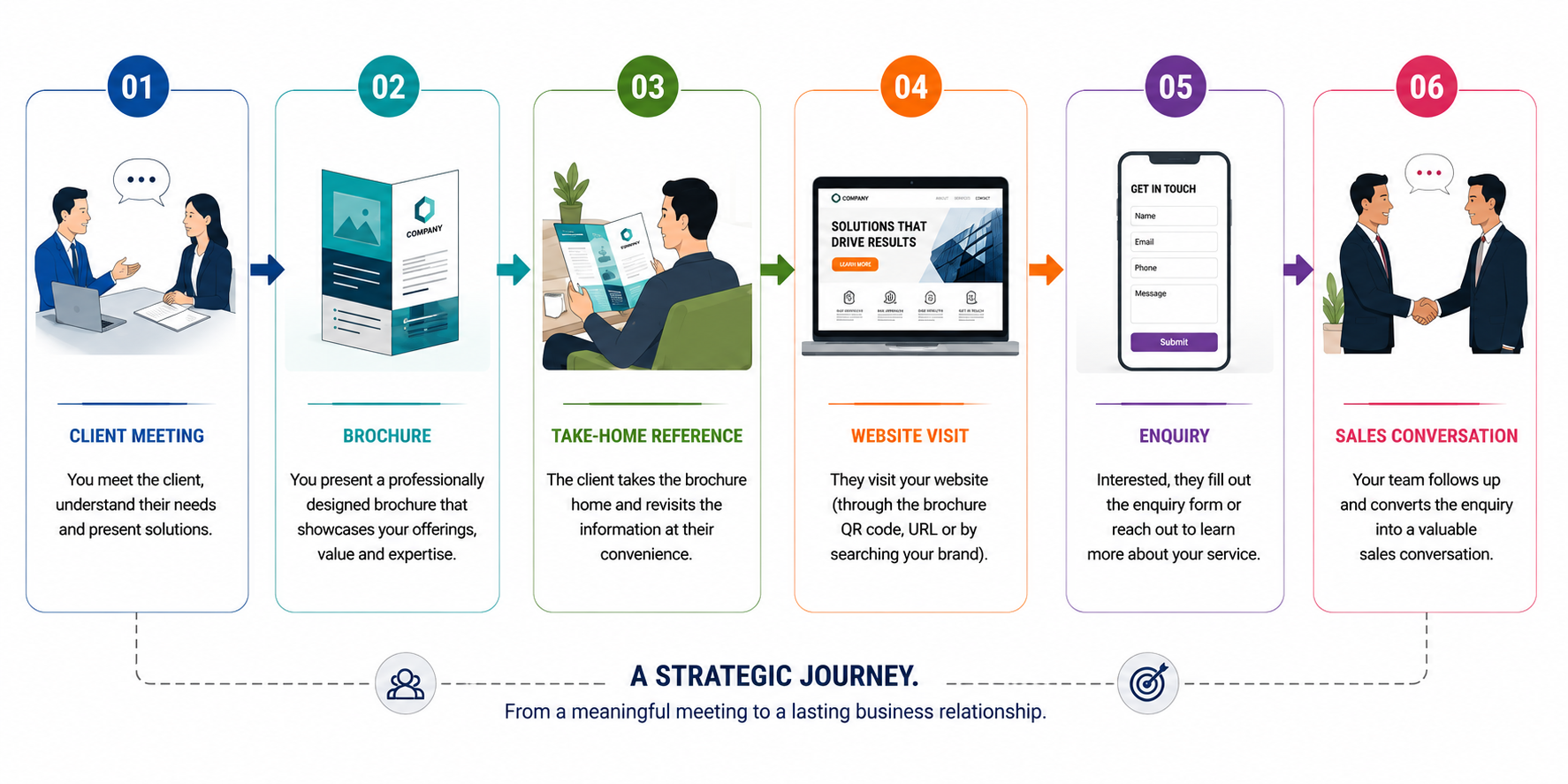
Brochures can also act as a sales enablement tool.
A salesperson can use one during a meeting to explain their services, showcase products, or compare packages. Brochures help present important company information.
More importantly, the conversation doesn’t have to end when the meeting does.
The prospect can keep the brochure and revisit to connect with the business later. This is how a brochure actually makes a difference in business meetings.
Brochures are an ideal choice for exhibitions, conferences, networking events, showroom visits, and face-to-face sales meetings.
Here’s the interesting part: print can stand out because everyone is focused on digital.
When consumers are busy scrolling on social media, you can take the lead with a strong brochure design. Creating a strong brochure design requires professional brochure design services.
A physical brochure can interrupt the scrolling and distractions.
It’s not about abandoning digital advertising. It’s about creating variety in your marketing mix. The lesson is simple: don’t assume younger audiences automatically ignore physical marketing.
Running out of strong brochure design ideas? Get in touch today with our experts!
Modern brochure design doesn’t end with a print. A print brochure now has a QR code, and your brochure can transform into:
This makes the brochure much easier to integrate into an omnichannel campaign for easy conversion.
One of the biggest strengths of a brochure is its lifespan.
A prospect may not need your service today. But if your brochure is useful, attractive, and easy to understand, they may keep it until the need arises.
This is particularly valuable for high-consideration purchases such as:
The brochure becomes a physical reminder of your brand.
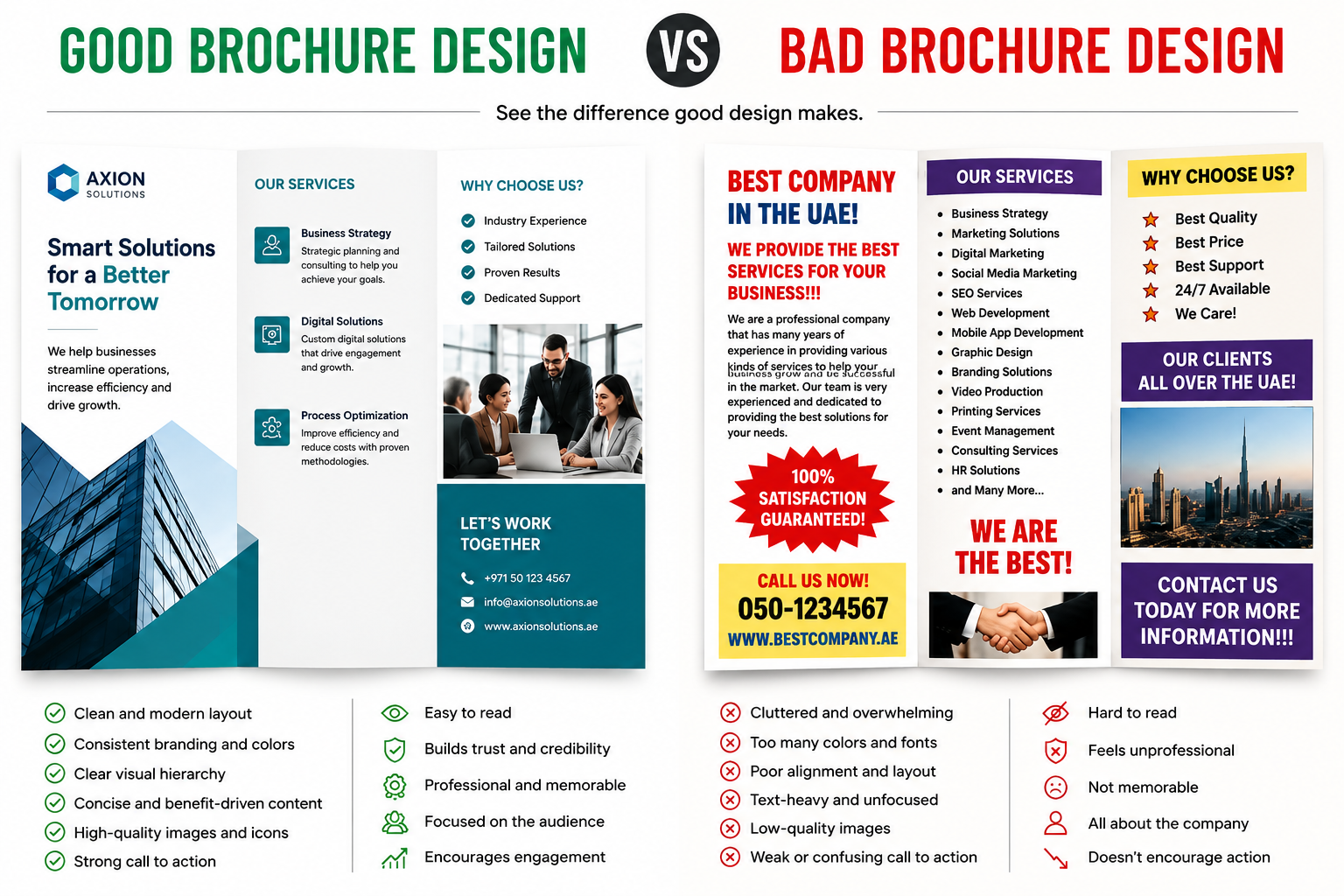
The above image clearly shows what a good and bad brochure design look like.
Having a brochure isn’t enough. The design has to earn attention.
A strong brochure should include:
Readers should immediately understand what matters most. Use headings, subheadings, images, spacing, and typography to guide the eye.
Colours, fonts, imagery, and messaging should align with your website and other marketing materials.
Avoid turning every page into a wall of text. Use short paragraphs, bullet points, statistics, and visual elements to make information easier to scan.
Low-resolution or generic images can instantly make a brochure look amateur and unprofessional. Use visuals that reinforce the message and brand positioning.
Don’t leave readers wondering what to do next.
Tell them to take the real action like:
Visit our website. Call us. Scan the QR code. Book a consultation. Request a quote.
A high-performing brochure should take the reader through a logical decision-making journey.
| Section | Purpose |
| Cover | Capture attention |
| Company introduction | Establish identity |
| Problem/Need | Show relevance |
| Products or services | Present the solution |
| Benefits | Explain value |
| Testimonials/Case studies | Build trust |
| Differentiators | Show why you’re different |
| CTA | Encourage action |
| Contact/QR code | Make conversion easy |
Think of the brochure as a mini sales journey, not simply a collection of company information.
Read more: Effective Brochure & Flyer Design Tips for Marketing Succcess
There doesn’t have to be one single answer.
It’s all about understanding your audience and platform. A printed brochure can work particularly well at exhibitions, meetings, retail locations, events, and sales presentations.
Whereas a digital brochure can be useful for email campaigns, websites, remote sales, proposals, and social media.
The smartest approach is often to design one as per your audience. When focusing on brochure design Dubai, it’s important to create a strong visual system and adapt it as per current trends.
For example:
Printed Brochure → QR Code → Digital Landing Page → Online Enquiry
This gives customers the convenience of digital while preserving the physical impact of print design.
Even a good brochure idea can fail because of poor execution.
Avoid these common mistakes:
Print isn’t impossible to track. You can add measurable digital elements such as:
Adding these elements means you can understand how many people scanned it, visited the page, submitted a form, or contacted your business.
That’s where traditional and digital marketing become much more powerful together.
A brochure is essential, especially if you’re running a business that requires better exposure. A business needs a brochure:
If you’re creating a brochure simply because “every company needs one,” it’s probably worth reconsidering.
But if you have a clear audience, message, purpose, and conversion goal, professional brochure design can become a valuable marketing asset.
So here’s the thing! Brochures aren’t outdated; old designs are. The brochure itself isn’t the competitive advantage. The strategy and design behind it are.
A generic, text-heavy brochure may end up in the recycling bin. strategically designed one can strengthen your brand, support your sales team, explain complex services, and send prospects directly to your digital channels.
That’s why brochure design still has a place in modern marketing.
The goal isn’t to choose between print and digital. It’s to create a connected customer experience where every marketing touchpoint works together.
If your business needs a brochure that looks professional, communicates clearly, and fits into a wider brand strategy, Dubai Monsters can help with a professional brochure tailored to your business and audience.
Yes. Brochures remain useful for businesses that need a tangible way to communicate information, support sales conversations, and reinforce brand identity.
Mahnoor Khan
October 13, 2026  Mahnoor Khan
September 23, 2026
Mahnoor Khan
September 23, 2026 Table of Contents
